LIFTING THE LID ON THE NAPOLI

Is the Napoli ‘Gull heaven’?
Q&A with local expert Steve Waite
If all media reports are believed, bird life in Lyme Bay was heavily impacted upon in the early stages of the Napoli incident.
While it is easy to focus on the drama of the oiled birds, 21 year old Steve Waite can tell a different story.
He is an independent researcher living in Seaton and along with a group of keen ornithologists monitoring birdlife on the River Axe estuary and at sea the area, has documented a gull-boom.
Prior to the Napoli’s arrival in Lyme Bay, what species of Gull would you expect to see in the area and roughly what were their numbers?
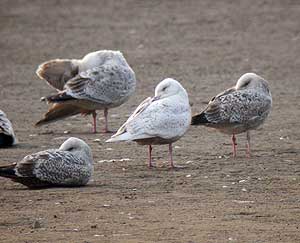 Herring (several thousand counted in an average day), Great Black-backed (up to a thousand counted in an average day), Lesser Black-backed (between 5 and 20 counted in an average day), Common (50 counted in an average day) and Black-headed (2000+ counted in an average day) are the commonest Gulls in numbers.
When did you start noticing the changes to the number of Gulls in the area?
After the Napoli, it was clear there were many more Gulls about, large numbers were feeding on the sea off Branscombe – and these would rest and bathe in the river – increasing Gull numbers here. If you see the normal count for Common Gull (around 50), one day we had about 900!!!!
Can you tell me what types of Gull you’ve seen since the Napoli incident and if there are any you wouldn’t expect to see on Devon’s coastline?
The Laughing Gull, Bonaparte’s Gull and Ring-billed Gull (x3) are three are American Gulls we’ve had. From the north we have had Iceland Gull (6+ individuals) and Glaucous Gull (x3) and also larger numbers of Mediterranean Gulls and a couple of Little Gulls, though the appearance of the latter is probably more weather related.
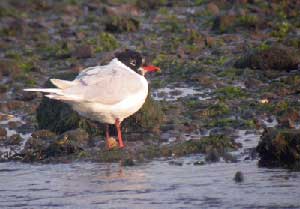 Do you attribute this increased species diversity and rise in number to the Napoli?
Local consensus is that the Napoli has done this. The appearance of the rarer species is really due to an increase in the commoner species. For example, in a flock of 100 Black-headed Gulls, the chances of finding an ‘odd’ rare Gull is lower than in a flock of 1000 Black-headed Gulls, the Gull flocks act as a magnet for other passing Gulls – it just so happened that the odd one or two were rarities!
Gulls feed on all sorts of scraps; most of the rarer species mingle in with their common cousins and do as they do.
There was an obvious supply of food from the Napoli, when a container of biscuits was swept into the sea – Gull heaven!
Do you think these changes could have any lasting impact on the existing ecosystems in the area – are they likely to breed here?
No - We don’t have enough suitable breeding habitats for them – they need huge shingle or sand banks that aren’t disturbed.
Given the heavy news coverage of the oil damage suffered by the Guillemot population in January, it is surprising to learn that some birds are flourishing as a result of the same incident. Was the Gull population affected by the oil?
Yes – the first morning afterwards I went down to the river and it was so upsetting seeing so many Gulls in distress. This affected so many birds; the numbers given by various organizations were such an underestimate – probably thousands under!
Gulls were a prime victim for the oil for two reasons.
1 – They would feed in the area around the boat, where the most oil is going to be, but most of all…
2 – every night EVERY SINGLE local Gull (of all species) roost on the sea, there are three main roosts locally, one on the sea off Axmouth Harbour, one (mainly for Black-headed Gulls) on the sea off Seaton Hole, and a large one for large Gulls on the sea off Beer Beach. Gulls travel for several miles (probably up to 30 miles) to get to these roost sites, so if they get oiled over night, the next day they disperse in all directions – meaning counting the true numbers of affected Gulls is impossible.
What’s your personal experience of dealing with the oiled birds from the Napoli? Did you encounter many gulls amongst them?
Oiled Gulls aren’t like Auks, which you can just pick up from the beach. Gulls are active until the bitter end, even if they are jet black in oil, they will still run/fly away from you. I counted oiled birds daily, but of course I didn’t know if the oiled birds I saw one day were the same as the ones the next, most probably not, as counts within the different species varied. For a couple of months after the Napoli, whenever a southerly wind came across, it must have disturbed oiled from the seabed which would bring a whole new batch of oiled Gulls.
A nice story comes from Colyton (about 3 miles inland!): A resident Herring Gull in a birdwatchers garden after the Napoli, came down to drink in the bird bath and it was covered in oil. Luckily though, after a few weeks, the oil patch receded, and the Gull looked healthier – he made a full recovery!
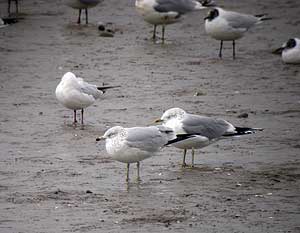
Gulls photographed by Steve Waite.